


The non-renewable energy, for example, the fósseis fuels, is not possible to restitute what we spend. At some moment they go to finish and they can be necessary millions of years of similar evolution to be able to count again on them. They are those whose reserves are limited and are being devastadas with the use. The main ones are the nuclear energy and the fósseis fuels (oil, natural gas and coal).

And nuclear power:
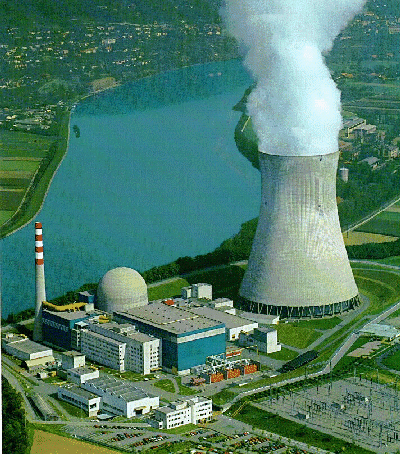
The atomic nuclei of elements heavy as the Uranian one, can be disintegrated (nuclear fissão or nuclear split) and to liberate radiating and kinetic energy. Thermonuclear plants use this energy to produce electricity using turbines the vapor.
Types Of Renewable Energy
Solid biomass is mostly commonly usually used directly as a combustible fuel, producing 10-20 MJ/kg of heat.
Its forms and sources include wood fuel, the biogenic portion of municipal solid waste, or the unused portion of field crops. Field crops may or may not be grown intentionally as an energy crop, and the remaining plant byproduct used as a fuel. Most types of biomass contain energy. Even cow manure still contains two-thirds of the original energy consumed by the cow. Energy harvesting via a bioreactor is a cost-effective solution to the waste disposal issues faced by the dairy farmer, and can produce enough biogas to run a farm.
With current technology, it is not ideally suited for use as a transportation fuel. Most transportation vehicles require power sources with high power density, such as that provided by internal combustion engines. These engines generally require clean burning fuels, which are generally in liquid form, and to a lesser extent, compressed gaseous phase. Liquids are more portable because they can have a high energy density, and they can be pumped, which makes handling easier.
Non-transportation applications can usually tolerate the low power-density of external combustion engines, that can run directly on less-expensive solid biomass fuel, for combined heat and power. One type of biomass is wood, which has been used for millennia. Two billion people currently cook every day, and heat their homes in the winter by burning biomass, which is a major contributor to man-made climate change global warming. The black soot that is being carried from Asia to polar ice caps is causing them to melt faster in the summer. In the 19th century, wood-fired steam engines were common, contributing significantly to industrial revolution unhealthy air pollution. Coal is a form of biomass that has been compressed over millennia to produce a non-renewable, highly-polluting fossil fuel.
Wood and its byproducts can now be converted through processes such as gasification into biofuels such as woodgas, biogas, methanol or ethanol fuel; although further development may be required to make these methods affordable and practical. Sugar cane residue, wheat chaff, corn cobs and other plant matter can be, and are, burned quite successfully. The net carbon dioxide emissions that are added to the atmosphere by this process are only from the fossil fuel that was consumed to plant, fertilize, harvest and transport the biomass.
Processes to harvest biomass from short-rotation trees like poplars and willows and perennial grasses such as switchgrass, phalaris, and miscanthus, require less frequent cultivation and less nitrogen than do typical annual crops. Pelletizing miscanthus and burning it to generate electricity is being studied and may be economically viable.

Solar Energy
The solar energy is that energy gotten for the light of the Sun, can be caught with solar panels. It is a source of life and origin of the majority of the other forms of energy in the Land. To each year the solar radiation brought for the land takes energy equivalent to some thousands of times the amount of energy consumed for the humanity. Choosing a good solar radiation, this can be transformed into other forms of energy as heat or electricity using solar panels.
Through solar collectors, the solar energy can be transformed into thermal energy, and using fotovoltaicos panels the luminous energy can be converted into electric energy. Both the processes do not have nothing to see ones with the others in terms of its technology. Exactly thus, the solar thermal central offices use thermal solar energy from solar collectors to generate electricity.
It has two components in the solar radiation: direct radiation and diffuse radiation. The direct radiation is the one that comes directly of the sun, without intermediate reflections or refractions. The diffuse one, is emitted by the sky during the day, thanks to the many phenomena of reflection and refraction of the solar atmosphere, in clouds, and the remaining elements of atmospheric and the terrestrial one. The direct reflected radiation can be intent and of use, even so it is not possible to concentrate dispersed the light that comes of all the directions. However, as much the direct radiation how much the diffuse radiation is usable.
It is possible to differentiate between active and passive receivers in which the first ones use mechanisms to guide the receiving system route to the sun (called following) better to attract the direct radiation.
A great advantage of the solar energy is that it allows the energy generation, in the same local of consumption, through the integration of the architecture. Thus, we will be able to take the systems of distributed generation, where almost to eliminate completely on losses to the transports, that represent currently about 40% of the total, and the energy dependence.

Wind Energy
Airflows can be used to run wind turbines. Modern wind turbines range from around 600 kW to 5 MW of rated power, although turbines with rated output of 1.5–3 MW have become the most common for commercial use; the power output of a turbine is a function of the cube of the wind speed, so as wind speed increases, power output increases dramatically. Areas where winds are stronger and more constant, such as offshore and high altitude sites, are preferred locations for wind farms.
Since wind speed is not constant, a wind farm's annual energy production is never as much as the sum of the generator nameplate ratings multiplied by the total hours in a year. The ratio of actual productivity in a year to this theoretical maximum is called the capacity factor. Typical capacity factors are 20-40%, with values at the upper end of the range in particularly favourable sites. For example, a 1 megawatt turbine with a capacity factor of 35% will not produce 8,760 megawatt-hours in a year, but only 0.35x24x365 = 3,066 MWh, averaging to 0.35 MW. Online data is available for some locations and the capacity factor can be calculated from the yearly output.
Globally, the long-term technical potential of wind energy is believed to be five times total current global energy production, or 40 times current electricity demand. This could require large amounts of land to be used for wind turbines, particularly in areas of higher wind resources. Offshore resources experience mean wind speeds of ~90% greater than that of land, so offshore resources could contribute substantially more energy. This number could also increase with higher altitude ground-based or airborne wind turbines.[ Relative costs of wind, coal and nuclear power are given here.
Wind power is renewable and produces no greenhouse gases during operation, such as carbon dioxide and methane.

Geothermal energy
Geothermal energy is energy obtained by tapping the heat of the earth itself, usually from kilometers deep into the Earth's crust. It is expensive to build a power station but operating costs are low resulting in low energy costs for suitable sites. Ultimately, this energy derives from heat in the Earth's core.
Three types of power plants are used to generate power from geothermal energy: dry steam, flash, and binary. Dry steam plants take steam out of fractures in the ground and use it to directly drive a turbine that spins a generator. Flash plants take hot water, usually at temperatures over 200 °C, out of the ground, and allows it to boil as it rises to the surface then separates the steam phase in steam/water separators and then runs the steam through a turbine. In binary plants, the hot water flows through heat exchangers, boiling an organic fluid that spins the turbine. The condensed steam and remaining geothermal fluid from all three types of plants are injected back into the hot rock to pick up more heat.
The geothermal energy from the core of the Earth is closer to the surface in some areas than in others. Where hot underground steam or water can be tapped and brought to the surface it may be used to generate electricity. Such geothermal power sources exist in certain geologically unstable parts of the world such as Chile, Iceland, New Zealand, United States, the Philippines and Italy. The two most prominent areas for this in the United States are in the Yellowstone basin and in northern California. Iceland produced 170 MW geothermal power and heated 86% of all houses in the year 2000 through geothermal energy. Some 8000 MW of capacity is operational in total.
There is also the potential to generate geothermal energy from hot dry rocks. Holes at least 3 km deep are drilled into the earth. Some of these holes pump water into the earth, while other holes pump hot water out. The heat resource consists of hot underground radiogenic granite rocks, which heat up when there is enough sediment betweenthe rock and the earths surface. Several companies in Australia are exploring this technology.

Tidal Energy
The energy of the seas is the energy that if it gets from the movement of the waves, of the tides or of the temperature difference it enters the water levels of the sea. It occurs due to gravitational force between the Moon, the Land and the Sun, that cause the tides, that is, the difference of average height of the seas in accordance with the relative position between these three astros. This difference of height can be explored in strategical places as the gulfs, bays and estuaries that use hydraulical turbines in the natural circulation of the water, together with the deposit and canalization mechanisms, to advance on a axle. Through its linking to an alternator, the system can be used for the electricity generation, transforming, thus, the energy of the tides, in electric energy, a more useful and usable energy.
The energy of the tides has the quality of being renewable as primary power plant is not depleted by its exploration and, is clean, a time that, in the transformation of energy does not produce pollutants derived in the operational phase. However, the relation enters the amount of energy that can be gotten with the current economic resources and the costs and the ambient impact of the installation of devices for its process had hindered a notable proliferation of this type of energy.
Other forms to extract energy from the energy of the oceanic waves are the energy produced for the movement of the waves of the ocean and energy due to the thermal gradient, that makes a difference of temperature between superficial and deep waters of the ocean

Energy of Hydrogen
The energy of hydrogen is the energy that if gets of the combination of hydrogen with the oxygen producing water vapor and freeing
rgy that is converted into electricity. Some vehicles exist that are moved hydrogen.The energy of hydrogen is the energy that if gets of the combination of hydrogen with the oxygen producing water vapor and freeing


Nenhum comentário:
Postar um comentário